eSIM vs Physical SIM: Which One Should You Choose?



Choosing between an eSIM vs physical SIM can be confusing, especially when you're preparing for a trip. Both options connect your phone to a mobile network, but they differ in how they are activated, transferred, and used. So, what is the difference between eSIM and SIM? And is eSIM better than physical SIM for travel? In this guide, we'll compare eSIM vs SIM, physical SIM vs eSIM, and the key pros and cons of each option. Whether you're deciding between a SIM or eSIM for your next trip or simply want to understand the technology, this guide will help you choose the option that fits your needs.
- eSIM vs SIM
- Is eSIM Better Than Physical SIM?
- What's the Difference Between SIM and eSIM?
- Pros and Cons of eSIM
eSIM vs SIM
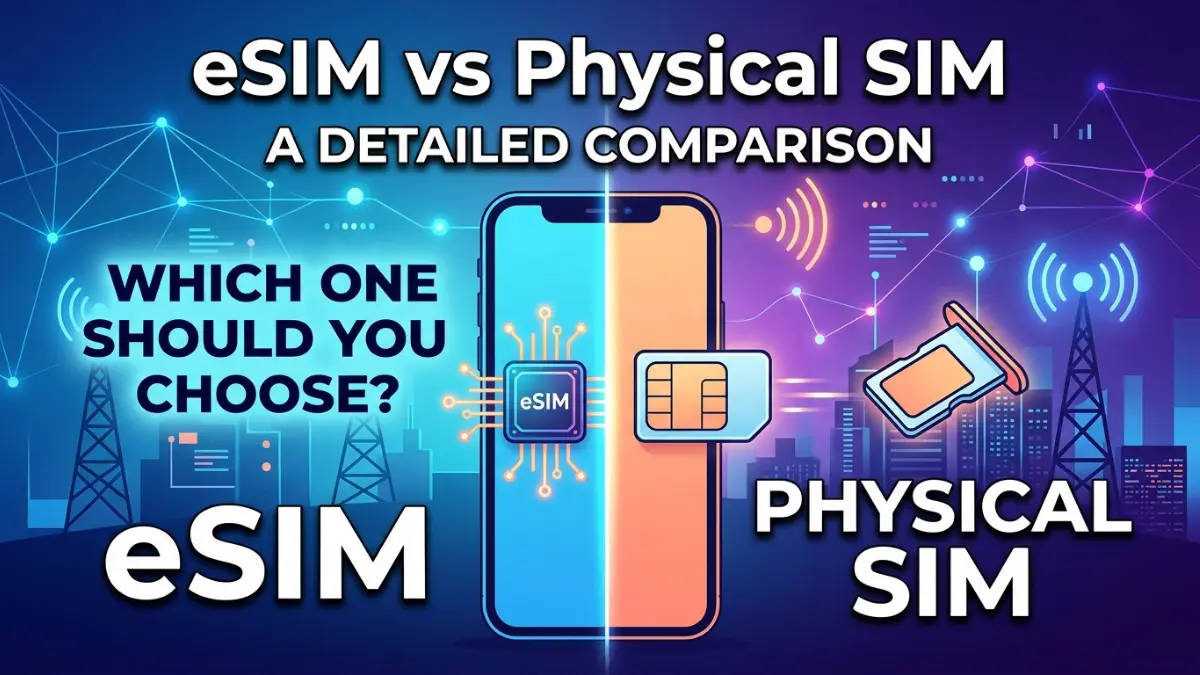
When comparing eSIM vs physical SIM, the biggest difference is how your mobile plan is stored and activated. A physical SIM card is a removable chip that you insert into your phone, while an eSIM is built directly into your device and can be activated digitally.
| Feature | eSIM | Physical SIM |
|---|---|---|
| Size | Built into the device, so there is no physical card to handle | Small removable card that comes in different sizes |
| Flexibility | Easy to add or switch between compatible mobile plans digitally | Usually requires changing the physical card when switching plans |
| Availability | Available from many carriers and travel eSIM providers, but depends on device and carrier support | Widely available and supported by most mobile phones |
| Transferability | Can be transferred between some compatible devices, but the process depends on the carrier | Can simply be removed and inserted into another compatible phone |
| Compatibility | Requires a device that supports eSIM | Works with most phones that have a physical SIM slot |
| Risk of loss | Cannot be physically lost because it is built into the phone | Can be lost or damaged when removed |
| Activation | Usually activated by scanning a QR code or following digital setup instructions | Usually activated by inserting the SIM card |
| Travel convenience | You can purchase and install a travel plan before your trip | You may need to buy or collect a SIM card at a store or airport |
You can choose either SIM or eSIM based on your phone compatibility. For frequent travelers, the convenience of an eSIM can make a noticeable difference. You can purchase a travel plan before departure and install it without carrying another tiny SIM card.
Is eSIM Better Than Physical SIM?
For many travelers, yes - an eSIM can be more convenient than a physical SIM. However, whether "is eSIM better" depends on your phone, carrier, travel destination, and how you use your mobile service.
So, is eSIM better than SIM? In terms of convenience and flexibility, an eSIM has several advantages.
How does an eSIM work?
Unlike a traditional SIM card, an eSIM does not need to be physically inserted into your phone. The eSIM is a digital SIM profile built into your device.
When you purchase an eSIM plan, the provider gives you the information needed to download the mobile plan. This may be provided through a QR code, an activation link, or an app.
Once the eSIM profile is installed, your phone can connect to the supported mobile network just like it would with a physical SIM.
This is why eSIM vs physical SIM is not really about whether one provides a completely different type of mobile signal. Both connect your phone to a cellular network. The main difference is how the SIM profile is stored and activated.
For example, if you're traveling abroad, you can purchase an eSIM before your flight, install it while connected to Wi-Fi, and activate it when you arrive. There is no need to remove your regular SIM card.
Why can eSIM be better?
There are several reasons people choose eSIM over physical SIM cards:
- No physical card to carry or lose
- Digital activation
- Easy to purchase before traveling
- Can support multiple mobile plans on compatible devices
- Useful for dual-SIM setups
- No need to open the SIM tray
- Convenient when switching between travel plans
Therefore, if you're asking "are eSIMs better?" The answer is often yes for travelers and people who frequently switch between mobile plans.
However, physical SIM cards still have an important advantage: universality. If your phone does not support eSIM, a physical SIM remains the straightforward option.
What's the Difference Between SIM and eSIM?
If you're searching for the difference between SIM and eSIM, the most important thing to understand is that both perform the same basic function: they identify your mobile subscription to a cellular network.
The difference between eSIM and SIM card technology is mainly the physical format and activation method.
| Category | eSIM | Physical SIM |
|---|---|---|
| Physical form | Embedded inside the phone | Removable plastic card |
| Network connection | Connects to a supported cellular network | Connects to a supported cellular network |
| Signal strength | Same for SIM or eSIM. Generally not inherently stronger or weaker | |
| Activation | Using digital. Learn How to Activate eSIM? A Beginner-Friendly Setup Guide. | Usually requires inserting the card |
| Changing plans | Can often be done digitally | Usually requires changing the SIM or getting a new one |
| Portability | Convenient for switching plans but device transfer depends on the carrier | Easy to move by physically transferring the card |
| Multiple plans | Some devices can store multiple eSIM profiles | Usually one physical SIM per slot |
| Device compatibility | Requires eSIM-compatible hardware. This is usually taken as one of the disadvantages of eSIM. | Requires a physical SIM slot |
| Risk of damage/loss | Cannot be physically lost | Can be lost, scratched, or damaged |
| Travel use | Can be purchased and installed before departure | Often purchased from stores, airports, or local carriers |
| Installation | QR code, activation link, or carrier app | Insert SIM card into the SIM tray |
| Removal | No physical removal required. Follow the instructions if you want to | Can be removed whenever needed |
Pros and Cons of eSIM
Understanding the pros and cons of eSIM can make it easier to decide between an eSIM card vs SIM card.
Benefits of eSIM vs Physical SIM
1. No physical SIM card to carry
One of the biggest advantages of eSIM is that there is no tiny card to handle. When traveling, you do not need to worry about removing your regular SIM and putting it somewhere safe. This also reduces the chance of losing your home SIM while using a travel SIM.
2. Easier for international travel
eSIM vs physical SIM for travel is where eSIM technology can be especially convenient. You can purchase a travel eSIM online before leaving home. After purchasing your plan, you can usually install it using a QR code or digital activation process.
Once you arrive at your destination, you can switch your mobile data to the travel eSIM without visiting a local store. For example, with NPN Travel, travelers can purchase an eSIM online and prepare it before their trip. This means you can focus on getting from the airport to your hotel instead of searching for a SIM shop after landing.
3. Keep your regular SIM active
Is eSIM or physical SIM better if you want to keep your original number? Absolutely eSIM! Many compatible phones allow you to use an eSIM alongside a physical SIM. This can be useful when traveling because you can keep your regular number available while using the travel eSIM for mobile data.
For example:
- Physical SIM: Your regular/home number
- eSIM: Your travel data plan
This setup can be particularly useful if you still need to receive calls or messages from your regular number while abroad.
4. Easy to switch between plans
With an eSIM-compatible phone, you can store multiple eSIM profiles depending on your device and carrier. This can make it easier to switch between mobile plans when traveling to different countries. Instead of keeping several physical SIM cards in your wallet, your phone can manage compatible digital profiles.
5. Less physical handling
From a safety perspective, is an eSIM better? A physical SIM requires a SIM tray and a removable card. An eSIM is already built into your device. This means there is no need to use a SIM ejector tool every time you change your SIM.
Disadvantages of eSIM
Despite its advantages, eSIM also has some limitations.
1. Not every phone supports eSIM
This is one of the biggest eSIM disadvantages. Older smartphones and some regional versions of newer phones may not support eSIM. Before purchasing an eSIM, check whether your specific phone model and regional version support it.
2. Carrier support varies
Even if your phone supports eSIM, not every carrier or mobile plan necessarily supports it. This means you should check both device compatibility and carrier support before purchasing.
3. Transferring an eSIM can be less straightforward
The biggest difference between eSIM and SIM card is their form factor. With a physical SIM, you can usually remove the card from one compatible phone and insert it into another. With an eSIM, moving a mobile plan to another device may require following the carrier's transfer or reactivation process. You could view this as one of the eSIM disadvantages, but it also serves as a security measure.
4. Setup can be unfamiliar for beginners
Installing an eSIM is usually simple, but first-time users may find the process less intuitive than inserting a physical SIM. Fortunately, most travel eSIM providers provide installation instructions to guide users through the process.
Conclusion
When comparing eSIM vs physical SIM, both options provide the same fundamental connection to a mobile network, but they offer different ways to manage your mobile plan. A physical SIM is familiar, widely supported, and easy to move between compatible phones. An eSIM offers more flexibility, digital activation, and convenience—especially for international travel.
For travelers, eSIM vs physical SIM for travel often comes down to convenience. With a travel eSIM such as NPN Travel, you can prepare your mobile data plan before departure without carrying or changing a physical SIM card.
Ultimately, whether you choose an eSIM or physical SIM depends on your phone, carrier, destination, and personal preferences.